You can become a key player in your organization by transforming the way industries function as an expert in GraphRAG and gen AI systems. With GraphRAG systems revolutionizing the way how industries function through increased precision and attention to detail, several industries have harnessed the power of GraphRAG. Here are a few examples.
Memgraph, a leader in open-source in-memory graph databases has introduced a new capability to accelerate business adoption of graph-based RAG systems across multiple sources. Also, IBM’s watsonx.ai, an enterprise-ready AI development studio, is now supporting GraphRAG. With leading industries adapting GraphRAG, it is ideal for you to understand the principles of this ground breaking concept that has driven innovation and automation across sectors. Understanding GraphRAG will make you the most sought after candidate in the job market.
Retrieval Augmented Generation (RAG) is a method that links external data sources to improve the results produced by large language models (LLMs). This approach is ideal for enabling LLMs to utilize private or domain-specific information and to mitigate hallucination problems. Consequently, RAG has been extensively adopted to enhance various GenAI applications, including AI chatbots and recommendation systems.
A standard AI Retrieval-Augmented Generation typically combines a vector database with an LLM, where the vector database is responsible for storing and retrieving contextual data relevant to user inquiries, while the LLM formulates responses based on the context obtained. Although this strategy is effective in numerous scenarios, it encounters difficulties with intricate tasks such as multi-hop reasoning or responding to questions that necessitate linking different pieces of information.
A Brief on GraphRAG
GraphRAG was launched by Microsoft Research in 2024 to overcome the shortcomings of large language models (LLMs). Conventional LLMs frequently encounter difficulties with intricate workflows, particularly when reasoning about private or structured data, due to their inability to comprehend the relationships between entities. GraphRAG addresses this challenge by utilizing graph databases to represent these relationships, which allows it to manage complex queries, access contextual information, and enhance accuracy in generative AI (gen AI) applications.
Knowledge Graph RAG represents an evolved form of retrieval-augmented generation (RAG) that integrates graph-structured data, including knowledge graphs (KGs). In contrast to standard RAG systems that depend on vector search for retrieving semantically similar text, GraphRAG capitalizes on the relational framework of graphs to obtain and process information according to domain-specific queries.
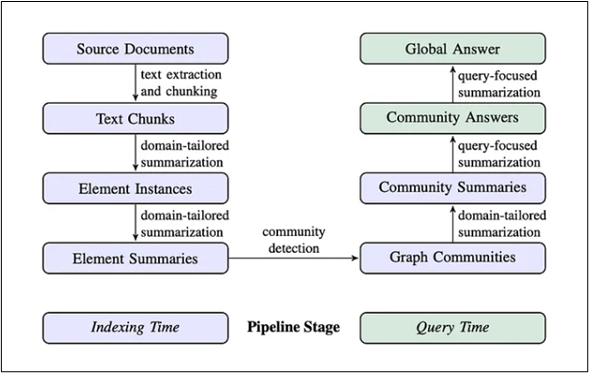
Working of Graph RAG
Query Processing
The user's query undergoes preprocessing to pinpoint key entities and relationships pertinent to the graph structure. Methods like named-entity recognition (NER) and relational extraction through machine learning are employed to align the query with nodes and edges in the graph.
Retriever
The retriever identifies and extracts pertinent content from external graph data sources based on the processed query. In contrast to conventional RAG systems that depend on vector embeddings for text or images, GraphRAG retrievers manage graph-structured data by utilizing both semantic and structural signals. They implement techniques such as graph traversal algorithms (including breadth-first search (BFS) or depth-first search (DFS) that navigate the graph to find relevant nodes and edges).
Organizer
The retrieved graph data is refined to eliminate irrelevant or noisy information through methods like graph pruning, reranking, and augmentation. The organizer ensures that the retrieved graph is clean, compact, and prepared for processing while maintaining essential contextual information.
Generator
The purified graph data is subsequently utilized to generate the final output. This may involve producing text-based answers using LLMs or constructing new graph structures for scientific applications, such as molecule design or knowledge graph expansion.
Applications of GraphRAG
Knowledge Graph RAG is utilized for query-focused text summarization. It aims to address specific user inquiries by retrieving and synthesizing information from a graph-structured representation of the text.
GraphRAG in Ecommerce
In sectors such as e-commerce and entertainment, GraphRAG empowers chatbots and recommendation systems to provide personalized experiences. For instance, in e-commerce, previous interactions between users and products can create a graph.
GraphRAG in Healthcare
In the healthcare sector, GraphRAG aids physicians in diagnosing patients with intricate symptoms by examining the relationships among diseases, symptoms, and treatments within a graph database. It retrieves pertinent medical studies, case reports, and drug information to propose possible diagnoses, emphasize effective treatment options, and even alert potential drug interactions. Knowledge Graph RAG also identifies unusual patterns that diverge from expected behavior. For instance, in financial services, it can recognize suspicious transaction patterns to prevent fraud or reveal cross-selling opportunities by analyzing customer behavior.
GraphRAG in Knowledge Management
GraphRAG can improve knowledge management by organizing and retrieving documents in a manner that enhances accessibility and relevance to specific queries. It evaluates the context and relationships among various documents, facilitating the quick and effective extraction of the most pertinent information.
How does GraphRAG Boost LLM Accuracy?
GraphRAG enhances the accuracy and context of LLMs by organizing data into knowledge graphs, which consist of entities and their relationships, rather than depending solely on semantic text segments. It improves comprehension through multi-hop reasoning, minimizes hallucinations by utilizing grounded, query-relevant data, and offers a more structured and explainable context that traditional vector-based RAG often overlooks.
- ● Deeper Context through Structured Connections: Rather than merely identifying semantically similar text, GraphRAG illustrates relationships (for instance, "Company A" acquired "Company B"). This enables the LLM to grasp how entities are interconnected, yielding thorough, multi-hop responses instead of disjointed, isolated facts.
- ● Reduced Hallucinations (Grounding): GraphRAG compels the LLM to generate answers based on structured data sourced from a knowledge graph, functioning as a grounding mechanism that guarantees factual and verified responses.
- ● Enhanced Retrieval Quality: GraphRAG improves the retrieval aspect of RAG by navigating the graph structure, enabling it to incorporate relevant, interconnected information that may not be explicitly stated in the search query, resulting in more precise, nuanced, and pertinent responses.
- ● Explainability and Provenance: By retrieving specific nodes and relationships, GraphRAG allows users to trace answers back to the exact source material (provenance), thereby increasing trust in the model's outputs.
- ● Managing Complex Queries: It excels at addressing intricate, multi-step queries that necessitate connecting various elements across a dataset, making it particularly suitable for domain-specific, knowledge-intensive tasks such as finance, law, and healthcare.
With the wide range of possibilities offered by GraphRAG, companies have begun implementing it along with context-aware generative AI solutions with knowledge graph semantic search to enhance their operations at various levels. Organizations across industries have harnessed ontology-driven AI retrieval and graphRAG to enhance their accuracy. There is a rise in demand for GraphRAG engineers across the industry. Also, did you know that there are AI agents that let you create a customized GraphRAG agent in minutes?
At Eduinx, we help you land your dream job as a gen AI expert and graphRAG engineer. We help you learn complex concepts through a practical hand-on approach through our virtual classrooms. As a leading edtech institute in India, Eduinx’s non academic mentors are here to guide you in completing capstone projects and land a high paying job. Get in touch with Eduinx to know more about our post graduate program in generative AI.