
Introduction
Three titles. All technically "AI jobs." All paying well. But if you pick the wrong one to chase, you could spend two years building the wrong skill set for a job that doesn't quite fit how you think or what you enjoy.
The confusion is real and it costs people. According to LinkedIn's Jobs on the Rise 2026 report, AI Engineer is now the fastest-growing job title in the US, while demand for ML roles has grown over 143% year-over-year. Back home, India is expected to face a shortage of over 230,000 data science professionals by 2026 , according to NASSCOM. So yes, demand is real. But demand for what, exactly?
This post breaks it down clearly: what each role actually does, what skills each requires, what they pay in India, and how to decide which path fits you.
What Does a Data Scientist Actually Do?
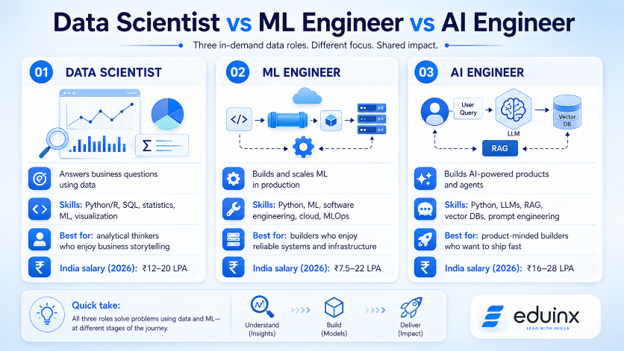
The cleanest way to understand a Data Scientist's role is this: they answer questions about the world using data. Why did sales drop in Q2? Which customer segment churns most? What factors predict loan default?
Data Scientists work closest to the business side of the house. They pull in raw data, run statistical analyses, build predictive models, and translate findings into recommendations that non-technical stakeholders can act on. A huge part of the job is storytelling: taking a complex model output and explaining why it matters to a product manager or a VP.
The core toolkit includes Python or R, SQL, statistics, applied ML, A/B testing, and data visualization. The work varies enormously by company. A Data Scientist at a BFSI firm might spend most of their time on credit risk models. At an e-commerce startup, they might run experimentation frameworks for conversion optimization.
One important thing many people miss: 73.9% of Data Scientist job postings emphasize communication skills, more than any single technical tool. If explaining your findings to a roomful of business stakeholders sounds like your nightmare, you may want to look at the other two roles.
Salary in India (2026): ₹12–20 LPA for mid-level roles in BFSI, e-commerce, and consulting. Senior roles in product companies can go higher.
Hiring managers for Data Scientist roles are drowning in candidates with similar course certificates. What actually differentiates you is a project where you defined the business question yourself, gathered or sourced data, ran the analysis, and documented your reasoning. Pick a domain you care about (fintech, healthcare, retail) and go deep on one problem.
What Does an ML Engineer Actually Do?
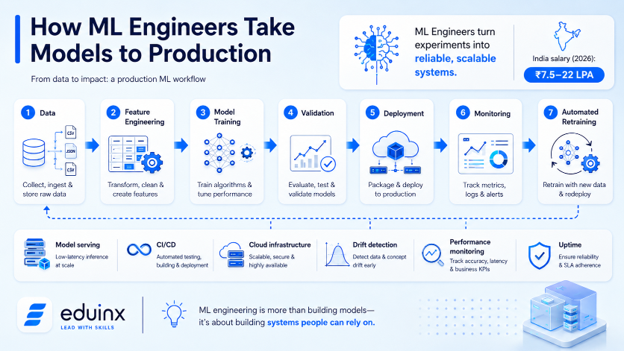
If a Data Scientist figures out what the model should do, the ML Engineer makes sure it actually does it in production, at scale, without breaking.
ML Engineers take a data scientist's model and make it run reliably in production. They handle model serving, retraining pipelines, performance monitoring, and the infrastructure that keeps predictions consistent when millions of requests hit the system simultaneously. The output is a deployed, maintained system. Not a Jupyter notebook. Not a research finding. A system.
This role sits at the intersection of software engineering and machine learning. You need to know ML theory well enough to debug model drift, but you also need to be comfortable writing production-grade code, managing CI/CD pipelines, working with cloud infrastructure (AWS, GCP, or Azure), and using MLOps tools like MLflow, Kubeflow, or SageMaker.
ML Engineers typically carry the highest on-call risk of the three roles because they own model serving and uptime. When a recommendation engine starts surfacing garbage results at 2 AM, the ML Engineer is the one who gets paged.
The payoff? A larger share of ML Engineer roles offer salaries above ₹20 LPA compared to Data Scientist roles. The reason is structural: engineers who keep production systems running are harder to cut when budgets tighten.
Salary in India (2026): ₹7.5–22 LPA depending on experience, with senior MLOps and production ML roles at product companies going considerably higher.
Most ML engineers in India still work in model training and experimentation. Very few have hands-on experience with model monitoring, feature stores, and automated retraining pipelines. If you build proficiency in tools like MLflow, Great Expectations, and a cloud ML platform, you'll stand out sharply in a crowded applicant pool.
What Does an AI Engineer Actually Do?
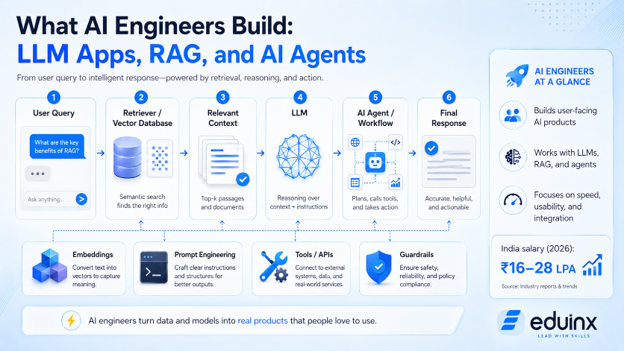
The AI Engineer is the newest of the three roles, and arguably the one with the most momentum right now.
Where Data Scientists analyze and ML Engineers build production ML systems, AI Engineers wire large language models, RAG pipelines, and AI agents into user-facing products. Think of the team that built your company's internal knowledge assistant, or the product that lets customers query documents in natural language. That's AI Engineering work.
The toolstack is different from the other two roles: LangChain, LlamaIndex, vector databases like Pinecone or Weaviate, embedding models, prompt engineering, and increasingly, agentic frameworks like LangGraph or CrewAI. You're less likely to be training models from scratch and more likely to be building systems on top of foundation models from OpenAI, Anthropic, or open-source alternatives.
This is why the AI Engineer role is accessible to strong software engineers who upskill strategically. You don't need a statistics PhD. You need solid Python, a clear mental model of how LLMs and retrieval systems work, and the ability to ship working products.
If you want to understand how these systems come together in enterprise settings, this deep dive on building AI agents with RAG for enterprise workflows covers the architecture in detail.
Salary in India (2026): GenAI Specialist roles command ₹16–28 LPA, and adding GenAI or LLM engineering skills to a traditional ML background delivers 20–40% higher offers at equivalent experience.
The Honest Comparison: Skills, Fit, and Trade-offs
Here's the truth that most career guides skip: these three roles select for different personality types, not just different skill sets.
Data Scientists tend to thrive when they enjoy ambiguity, can tolerate open-ended questions with no single right answer, and genuinely like working with business stakeholders. The job involves a lot of "we don't know what we're looking for yet" situations.
ML Engineers tend to be people who find deep satisfaction in making things reliable and fast. They like knowing that a system they built is handling ten million requests per day without errors. There's a craftsmanship quality to good ML engineering.
AI Engineers, especially in 2026, tend to be product-minded builders. They want to ship things people use. They care about user experience as much as model performance. The rise of agentic systems and LLM-powered products means AI Engineers are closer to product development than any traditional ML role.
The three roles exist because they solve three fundamentally different problems: Data scientists answer questions about the world. ML engineers build systems that make predictions at scale. AI engineers ship products powered by large language models. Get that framing right, and the right path becomes much clearer.
For Indian professionals specifically, here's a practical lens: if you're coming from a software engineering background, AI Engineering is the fastest bridge into high-paying AI work. If you're coming from a math or statistics background and love research, Data Science plays to your strengths. If you like systems, infrastructure, and production ownership, ML Engineering is your lane.
India is projected to host over 1 million active AI and ML roles by end of 2026, with AI skills now required in 11.7% of all job postings nationally. The market is large enough for all three roles to grow significantly. The question is which one fits how you think.
For more on how the AI stack is evolving and where LLM evaluation fits in, the breakdown of LLM evaluation metrics for production systems covers what actually matters when you're working with these models day-to-day.
How to Decide: A Simple Framework
Stop asking which role pays more. They all pay well at senior levels. Ask these questions instead:
- Do you like explaining your work to non-technical people? If yes, Data Science suits you. If you'd rather hand off findings to an engineer and move on, ML or AI Engineering is a better fit.
- Do you get satisfaction from building reliable systems? If "zero downtime" and "model drift detection" sound exciting, not boring, ML Engineering is your path.
- Do you want to build products people interact with? If you care about the end user experience and want to ship things quickly, AI Engineering in 2026 is your fastest route to impact and high compensation.
One more thing: the overlap is real and growing. A strong ML Engineer who understands LLM fine-tuning crosses into AI Engineering territory. A strong AI Engineer who learns MLOps fundamentals can own more of the stack. The best career move is to anchor in one role, go deep, and then expand deliberately rather than staying generalist.
Salaries are growing 15–20% per year across all three roles in India. The biggest risk, according to current hiring data, is staying generalist in a market that increasingly rewards depth.
Conclusion
Data Scientist, ML Engineer, AI Engineer: these are three genuinely distinct career paths, not interchangeable titles for "someone who works with AI." Each has a different core problem it solves, a different skill set it rewards, and a different personality type it suits.
In 2026, all three are in high demand in India, with real salary growth and a talent shortage working in your favor. But picking the right target matters. Define what kind of work energizes you, build deep skills in that direction, and invest in practical projects that demonstrate production thinking, not just course completion. The market will reward that clarity.
Frequently Asked Questions (FAQs)
1.What is the difference between a Data Scientist, ML Engineer and an AI Engineer?
Data Scientists use statistics and predictive modeling to answer questions in the business. The models are then deployed into production systems by the ML Engineers, where they can operate in a reliable manner at scale. AI Engineers create user-facing products with large language models, RAG pipelines, AI agents. Every role is a different problem in the field of AI.
2. Which role is best in 2026: Data Scientist, ML Engineer or AI Engineer?
The best role depends on your background. Choose Data Science if you enjoy analytics, statistics and business problem-solving. Choose ML Engineering if you like coding, model deployment, cloud and scalable systems. Choose AI Engineering if you want to build GenAI products, chatbots, copilots, RAG systems and AI agents.
For software engineers, AI Engineering or ML Engineering is usually the faster transition path because both roles reward strong coding and system-building skills.
3. Which is the highest-paid AI/data job in India in 2026?
Among AI and data roles in India, AI Engineer, GenAI Engineer, ML Engineer and MLOps Engineer are among the highest-paying roles in 2026. Salary varies by experience, company type, city, portfolio and production-level skills.
Glassdoor’s India salary data shows AI/ML-related career tracks can move from ML Engineer to Senior ML Engineer and Lead ML Engineer, with lead-level ranges going much higher than entry-level roles. Other 2026 salary guides place Data Scientist roles around ₹8–25 LPA, ML Engineer roles around ₹12–30 LPA, and AI/GenAI Specialist roles around ₹15–40+ LPA, depending on experience and skill depth.
4. What are the tools used by an AI Engineer?
The LangChain, LlamaIndex, vector databases (Pinecone, Weaviate), embedding models, and the agentic tools like LangGraph and CrewAI are all frequently used by the AI Engineers. The majority of work is done on top of foundation models from other platforms, such as OpenAI or Anthropic.
5. Can one become an ML Engineer or AI Engineer as a Data Scientist?
It is true that there is an intersection between these roles and it will be even more so in the future. A Data Scientist with good software engineering and MLOps skills can transition into ML Engineering, and a Data Scientist with proficiency in LLM-based tools such as LangChain can transition into AI Engineering. Experts say in one position and do a gradual expansion.
6. Will Data Science be worth it in 2026?
Yes, Data Science is definitely a career with a lot of potential in 2026 and India is expected to have over 230,000 data science professionals by 2026, according to NASSCOM. The salary range of the middle level lies between INR 12 LPA and INR 20 LPA, and the role is suitable for analytical, storytelling, and problem-solving individuals who are looking to solve complex business problems.
7. Which has better salary: AI/ML or Data Science?
In 2026, AI Engineering and ML Engineering usually have a salary premium over traditional Data Science, especially when the role involves production deployment, GenAI, MLOps, cloud or AI product development.
Data Science remains a strong career, but professionals with AI Engineering, ML Engineering, GenAI and MLOps skills are more likely to access higher-paying product-company and global capability center roles.
8. Which career path is best for high-paying AI jobs in India?
The strongest career path in 2026 is to combine software engineering + machine learning + GenAI + cloud deployment. This combination prepares you for AI Engineer, ML Engineer, GenAI Engineer, MLOps Engineer and AI Product Engineering roles.
Candidates who can not only build models but also deploy real AI products have a stronger chance of getting premium salaries.